
Latest News
Examining the Efficacy of Extended Reality Enhanced Behavioral Activation for Adults with Major Depressive Disorder: A Randomized Controlled Trial

Kim Bullock, M.D. and Margot Paul, Psy.D. were panelists on JMIR’s podcast and shared with John Torous, MD, MBI, how extended reality may be an efficacious method of delivering behavioral activation for adults with depression and explored how participant acceptability differs between a more immersive versus simpler device.
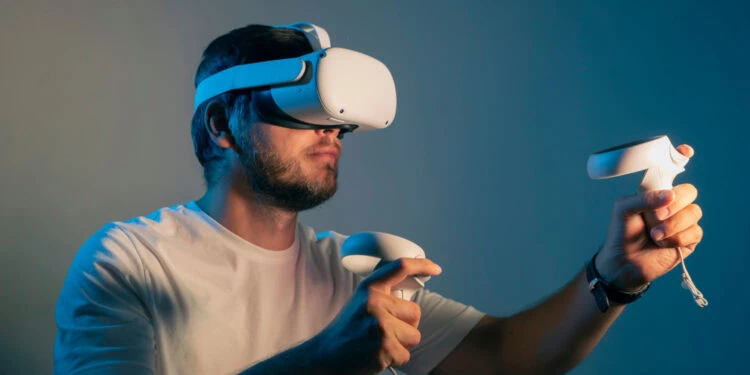
Margot Paul, Psy.D. was interviewed by Eric W. Dolan for PsyPost to discuss how extended reality may be an efficacious method of delivering behavioral activation for adults with depression.
Medical News Today highlighted the XR-enhanced BA for depression study conducted by Margot Paul, Psy.D., Kim Bullock, M.D., Jeremy Bailenson, Ph.D., and David Burns, M.D. (2024).
NeuroscienceNews.com covered the XR-enhanced BA for depression study conducted by Margot Paul, Psy.D., Kim Bullock, M.D., Jeremy Bailenson, Ph.D., and David Burns, M.D. (2024).
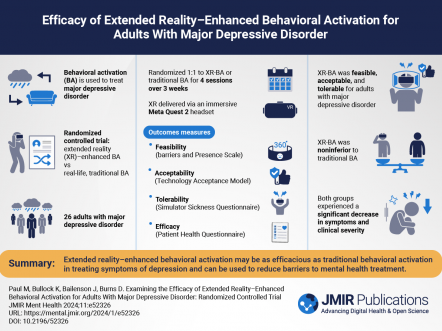
Margot Paul, Psy.D. was interviewed by Géraldine Zamansky for Radio France, “C’est ma santé” to discuss how extended reality may be an efficacious method of delivering behavioral activation for adults with depression.
Margot Paul, Psy.D. was interviewed by Mary Hughes for KCBS Radio to discuss how extended reality may be an efficacious method of delivering behavioral activation for adults with depression.
Using Virtual Reality for Hoarding Disorder | Stanford Medicine News Center
In a pilot study by Stanford Medicine researchers suggests that a virtual reality therapy that allows those with hoarding disorder to rehearse relinquishing possessions in a simulation of their own home could help them declutter in real life. The simulations can help patients practice organizational and decision-making skills learned in cognitive behavioral therapy — currently the standard treatment — and desensitize them to the distress they feel when discarding.


Can Virtual Reality Sessions Treat Chronic Pain? | NBC Nightly News
Dr. Kim Bullock, a neuropsychiatrist at Stanford University, says she made the remarkable discovery by accident. While studying virtual reality for conditions like severe anxiety, a welcome side benefit of that treatment: patients’ chronic pain disappeared.